Bottom Linear Gradient  Lines image

Video Content

Originally aired

60 minutes

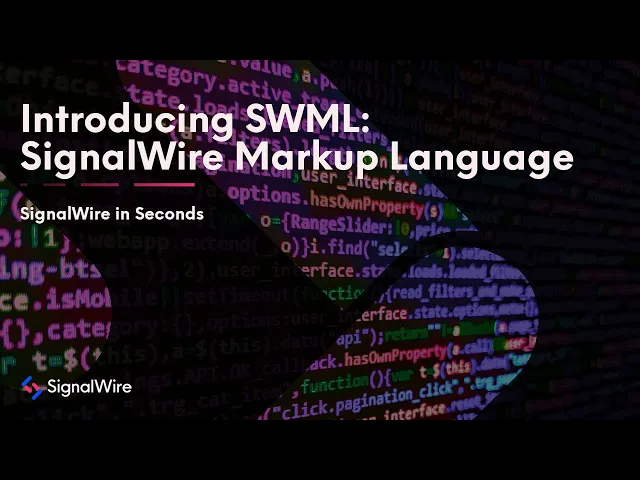
What is SWML?

Share

Angular Gradient Image

Build it free.

Create a space and ship your first call flow in minutes.

Subscribe

What Is SWML? Meet SignalWire’s Modern Call Flow Language

When it comes to real-time communications, flexibility and simplicity are key. That’s where SWML comes in.

See how SWML gives developers and businesses the ability to define call flows in a clean, readable format, using YAML or JSON, not legacy XML. Whether you’re creating basic IVRs or advanced AI-powered virtual assistants, SWML is designed to help you move faster, scale smarter, and build exactly what you need without unnecessary complexity.

Unlike traditional CPaaS tools that rely on clunky XML and complex voice webhooks, SWML provides a self-contained, declarative language for communication logic. It’s built on FreeSWITCH, one of the most trusted open source platforms in telecom, and is integrated directly into the SignalWire ecosystem.

Key Benefits:

  • Write in YAML or JSON for better readability and modern tooling

  • Define entire call flows in a single document—no more webhook juggling

  • AI-ready: Easily create natural language IVRs and smart agents

  • Built for security: Supports encrypted data transmission and secure AI interactions

  • Scales with you: From support lines to virtual events with conferencing, it adapts to your needs

Use Cases Covered in the Video:

  • AI-powered virtual assistants that gather info and perform tasks

  • Smart call queues and dynamic routing based on caller input

  • Secure data collection using SignalWire’s AI Gateway

  • Custom multi-party conferencing flows

Top Linear Gradient  Lines image

Frequently asked questions

Frequently asked questions

What is RCS messaging?

Rich Communication Services (RCS) is the next generation of mobile messaging, designed to replace SMS and MMS. It supports high-quality images and video, verified sender identities, read receipts, typing indicators, and interactive elements like carousels and quick replies, all within the phone's native messaging app.

What is RCS Business Messaging (RBM)?

RCS Business Messaging (RBM) applies RCS capabilities to brand-to-consumer communication. It lets businesses message customers from a verified brand identity instead of a phone number, share rich media and documents, offer quick replies and CTAs, and handle actions like appointment confirmations and payments without the customer leaving the chat.

Is RCS replacing SMS?

RCS is positioned as the successor to SMS, but the transition is gradual. Businesses should adopt RCS where supported while keeping SMS and MMS as fallback channels for devices and networks that don't yet support it.

Does iPhone support RCS?

Yes. Apple added RCS support starting with iOS 18, with RCS Business Messaging support arriving in iOS 18.1. Combined with existing Android support, this brings RCS to the large majority of smartphones in the US.

Is RCS more effective than SMS for customer engagement?

Yes. Nearly 80% of consumers say RCS makes them more likely to engage with a brand, and RCS campaigns can achieve click-through rates up to 7x higher than SMS thanks to rich media, interactivity, and verified sender trust.

ow do businesses start sending RCS messages?

Businesses must first register an RCS agent, an approval process involving Google, aggregators, and mobile operators. From there, they can define use cases like marketing, customer service, or appointment reminders. SignalWire guides businesses through registration and campaign planning.

Which industries benefit most from RCS?

Retail, finance, and healthcare are early leaders. Retailers use RCS for in-chat purchases and product carousels, financial institutions use it for secure verified messaging and account alerts, and healthcare providers use it for appointment scheduling and reminders.

Bottom Linear Gradient  Lines image

The Communications Stack for What's Next

APIs built for speed. Infrastructure built for scale. AI built in from day one.

The Communications Stack for What's Next

APIs built for speed. Infrastructure built for scale. AI built in from day one.

The Communications Stack for What's Next

APIs built for speed. Infrastructure built for scale. AI built in from day one.

The Communications Stack for What's Next

APIs built for speed. Infrastructure built for scale. AI built in from day one.